
Ventara Air+ CO2 WiFi single room MVHR with CO₂ sensing
Ventara Air+ CO2 WiFi is a single room heat recovery ventilator with a CO₂ sensor and a temperature sensor as standard. The CO₂ sensor switches from regeneration to supply above your set CO₂ level. Free cooling starts when outdoor temperature is within 1°C of your set temperature.
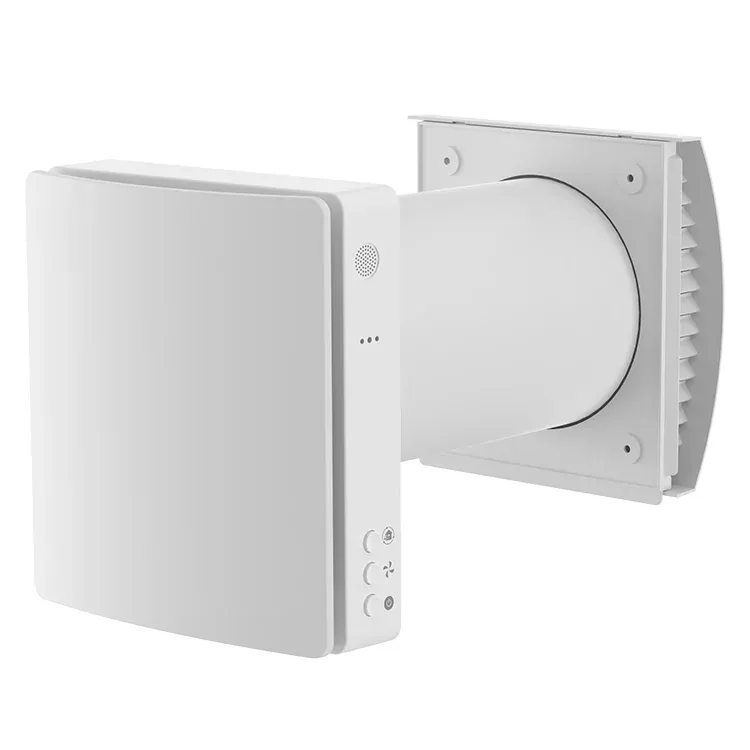
- maximum heat recovery
- 97%
- sensor as standard
- CO₂
- ingress protection
- IPX4
Who Air+ CO2 WiFi is for
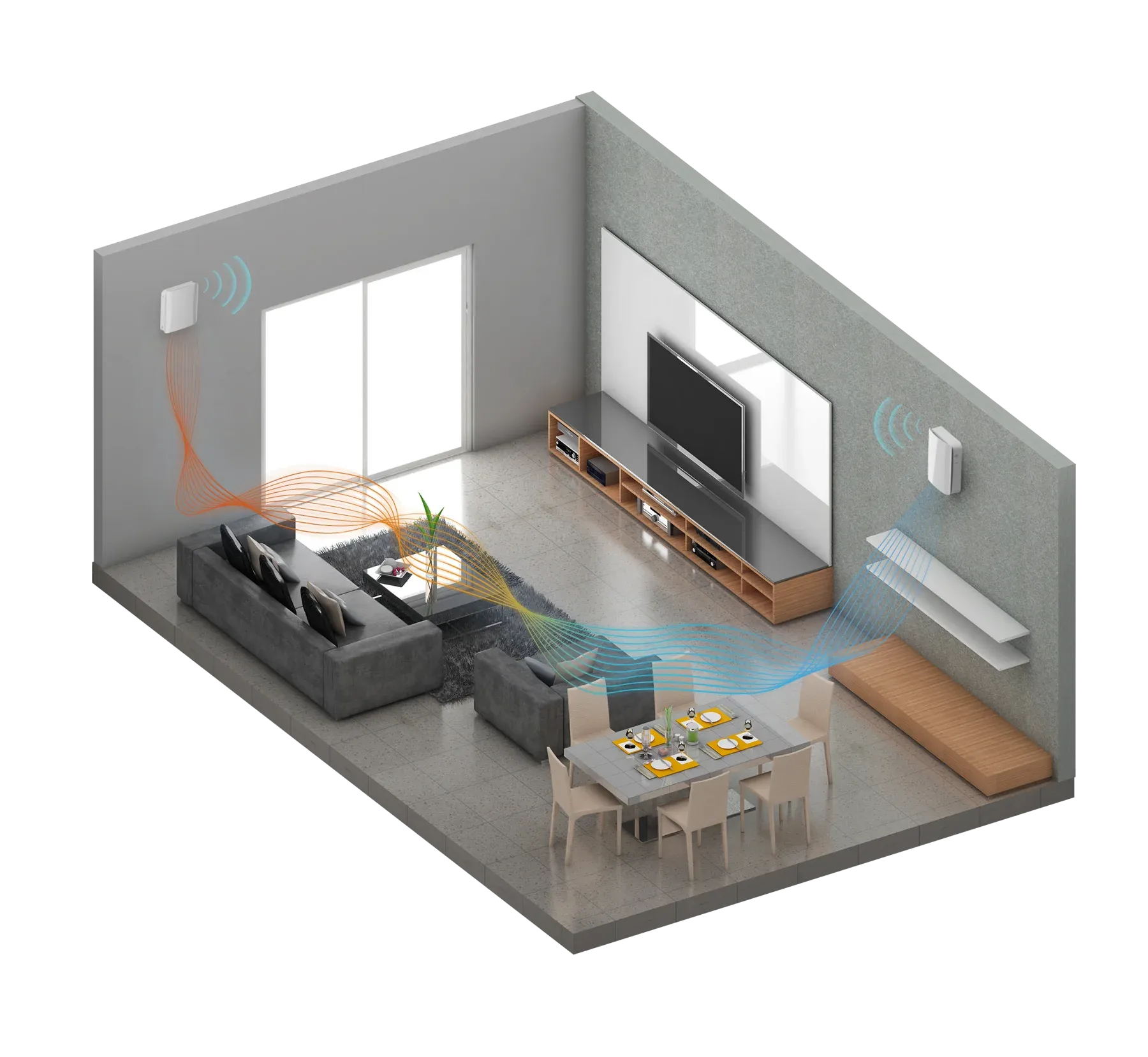
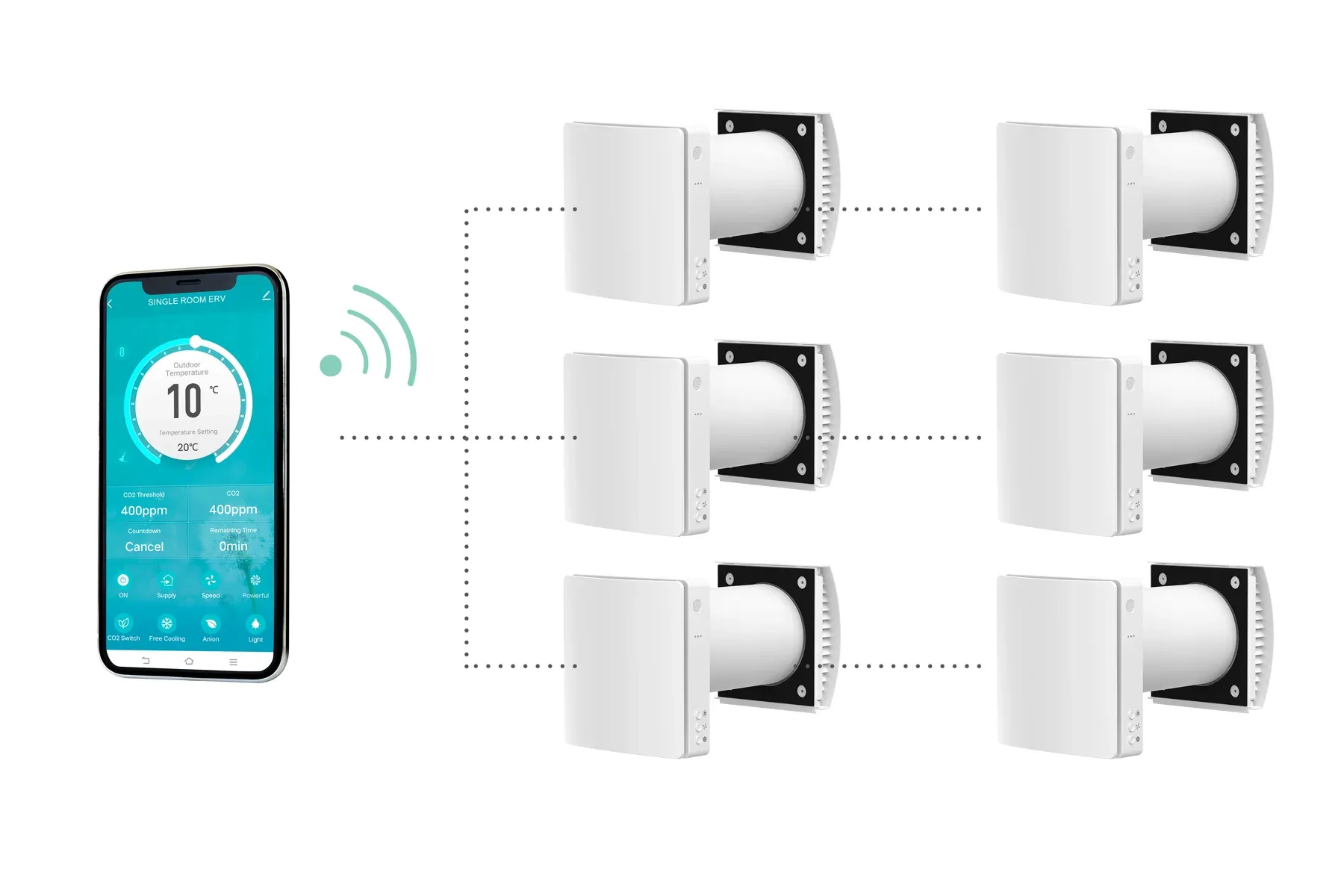
Air+ CO2 WiFi is for rooms where CO₂ matters. Its CO₂ sensor brings in more fresh air as the level rises. Its temperature sensor adds free cooling. Units work alone or as a wireless pair.
Need humidity control instead? See Air+ Humidity WiFi.
CO₂ control
Indoor CO₂ above the set value switches the unit from regeneration to supply. It stays in supply until CO₂ falls back below the set value.
Free cooling
A temperature sensor is standard. Outdoor temperature within 1°C of your set temperature triggers supply mode without heat recovery.
Magnetic front panel
The decorative panel attaches magnetically for a tight seal against wind. An auto shutter behind it stops back draught.
F7 filter as standard
Two pre-filters and an F7 filter come as standard. All three are treated against bacteria. Clean them with a vacuum or rinse them in water.
Antibacterial ceramic core
The cellular ceramic regenerator has a large contact surface and is treated to prevent bacterial growth.
Controls
Button, remote and Wi-Fi app with scene and group control. Works with Alexa and Google Assistant.
What the Air+ CO2 WiFi sensors do
Air+ CO2 WiFi changes mode in response to its sensors. Set CO₂ and temperature levels in the app. For humidity control choose Air+ Humidity WiFi.
- WhenCO₂ in the room rises above the level you setAir+ CO2 WiFi doesSwitches from regeneration to supply to bring in more fresh airUntilCO₂ falls back below your level
- WhenOutdoor temperature is within 1°C of your set temperatureAir+ CO2 WiFi doesFree cooling: supplies fresh air straight in without heat recoveryUntilThe free-cooling condition no longer applies
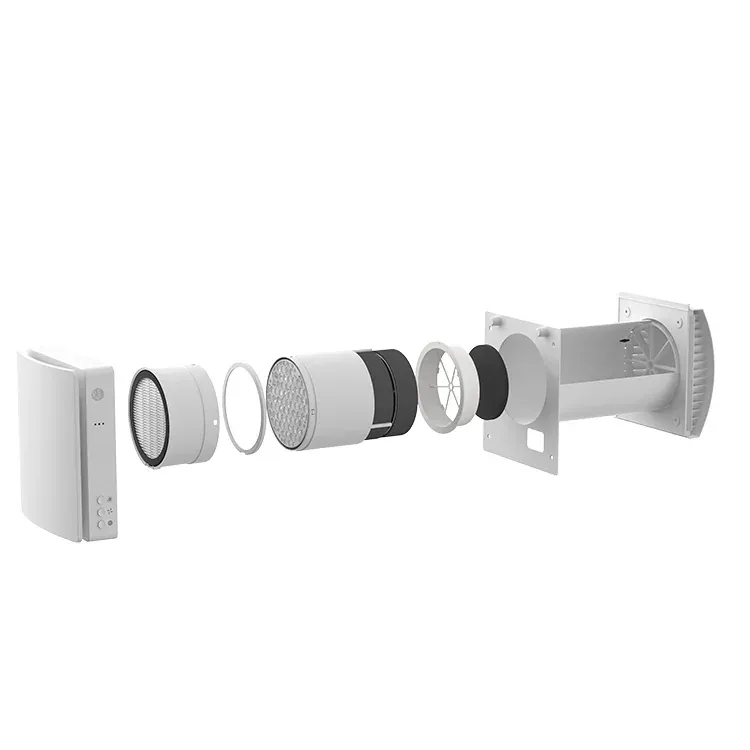
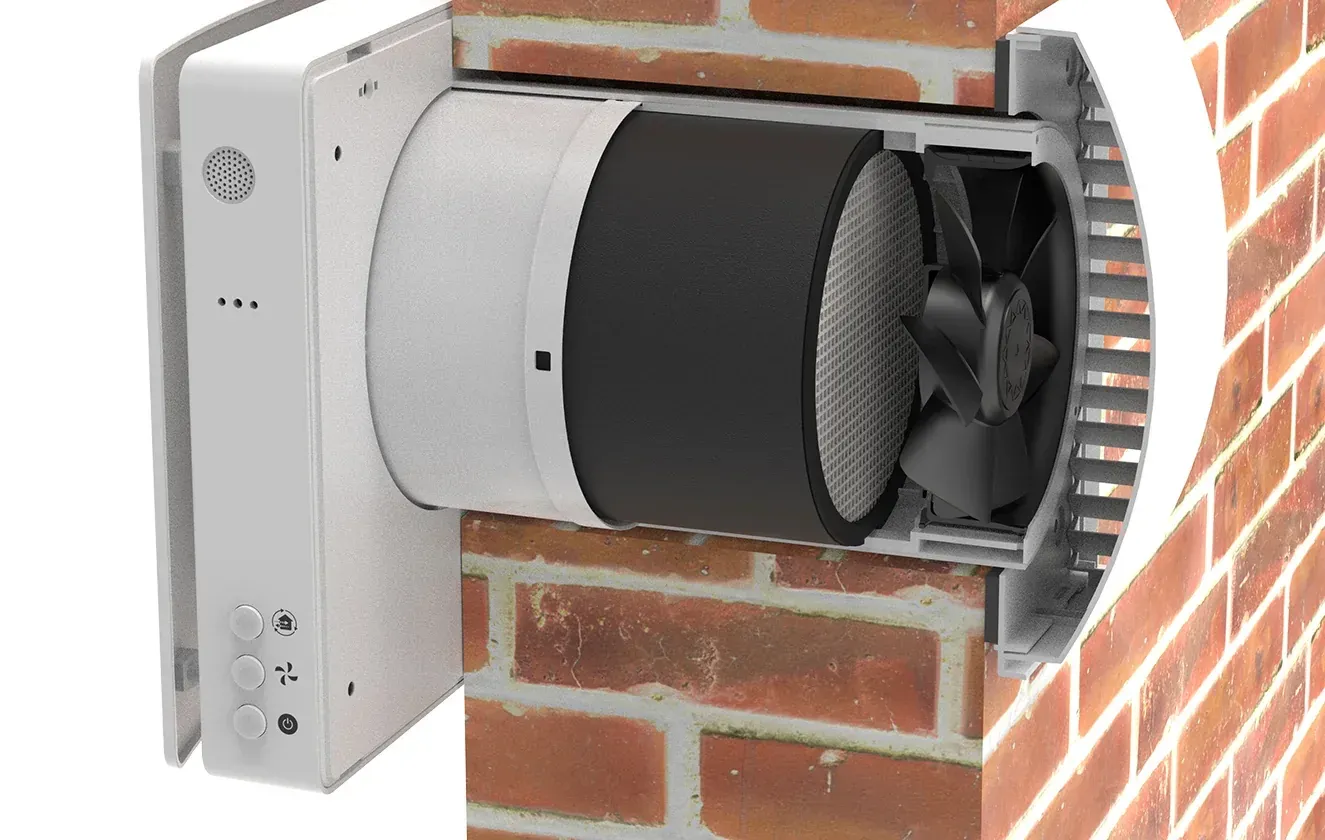
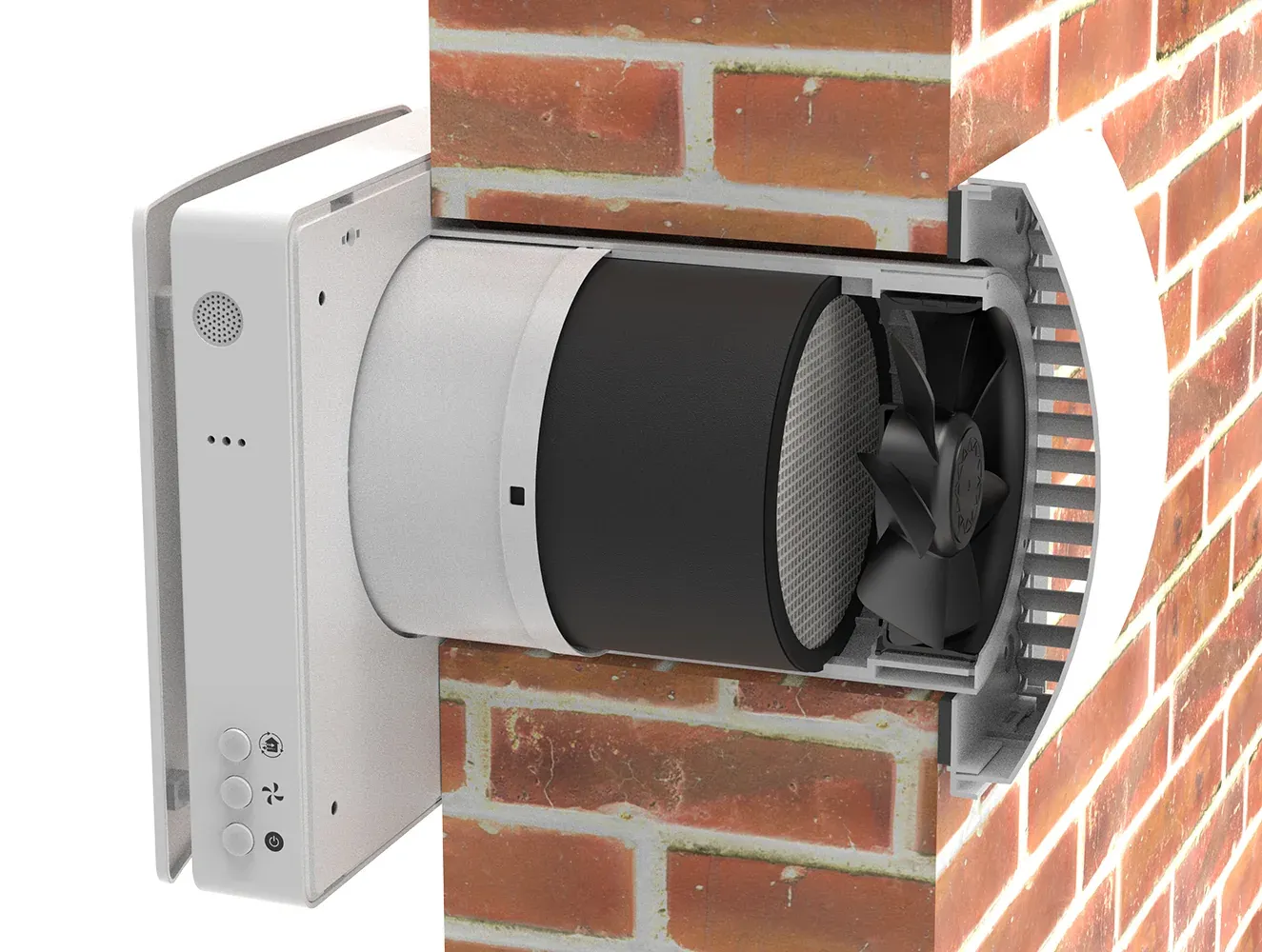
Inside Air+ CO2 WiFi
A simplified view of the main components from the Ventara catalogue. Match the numbers to the parts below.
- 1Front panelCurved and magnetic. An auto shutter behind it closes when the unit stops.
- 2Pre-filterTwo washable pre-filters as standard.
- 3F7 filterFitted as standard on Air+.
- 4Ceramic coreStores and returns heat. Maximum heat recovery efficiency of 97%.
- 5Reversible EC fanThree speeds. Reverses every 75 seconds in heat recovery mode.
- 6Wall sleeveThe 158 mm diameter duct through the outside wall.
- 7Outer hoodRainproof cover on the outside wall.
Air+ shown. The Air models have a square front panel and an optional F7 filter.Not to scale.
How quiet is Air+?
<32.7dB(A)
For comparison a quiet library is about 40 dB.
The Air+ features page states below 32.7 dB(A); its technical table lists 32.7 dB(A). Neither gives a speed or measuring distance. Everyday sounds are approximate references and not like-for-like tests. Everyday sound levels: whisper from ASHA (opens in a new tab), library and conversation from RNID (opens in a new tab).
The 75 second cycle
Air+ CO2 WiFi has one reversible fan and a ceramic core. Watch it store heat on the way out and hand it back on the way in. Drag the slider to stop at any second. The full explanation is in how single room heat recovery works.
What does Air+ CO2 WiFi cost to run?
Pick a setting and the hours it runs. The cost uses the catalogue power figure and the current Ofgem price cap rate of 26.32p per kWh.
£4.03a year
£0.34 a month · 15 kWh a year
Uses the catalogue power at each fan speed for Air+ CO2 WiFi. Estimate at the Ofgem price cap average electricity unit rate for 1 October to 31 December 2026 (standard variable tariff, Direct Debit, Great Britain average). The government has removed VAT from electricity bills from 1 October 2026 to 31 March 2027. Standing charge not included. Your rate depends on your region and tariff. Source: Ofgem, 26 August 2026 (opens in a new tab).
Air+ CO2 WiFi specifications
| Specification | Low | Medium | High | Boost |
|---|---|---|---|---|
| Airflow (m³/h) | 20 | 40 | 50 | 60 |
| Airflow (CFM) | 11.8 | 23.5 | 29.4 | 35.3 |
| Power (W) | 6 | 7 | 7.8 | Not stated |
| Current (A) | 0.04 | 0.05 | 0.06 | Not stated |
| Sound pressure | Below 32.7 dB(A) | |||
| Regeneration efficiency | Up to 97% | |||
| Ingress protection | IPX4 | |||
| Voltage | 100 to 240 V AC, 50/60 Hz | |||
| Max fan speed | 2,200 rpm | |||
| Duct diameter | 158 mm | |||
| Unit size | 239.6 x 258 x 499.7 mm | |||
| Wall depth (duct length) | 220 to 360 mm | |||
| Net weight | 4.2 kg | |||
Scroll the table sideways on a small screen to see every speed.
Airflow figures are for supply or exhaust mode with the F7 filter fitted. Heat recovery reaches up to 97% as air first enters the regenerator.
See every model side by side in the single room comparison.
Installing Air+ CO2 WiFi
- Drill one hole through the outside wall for the 158 mm duct. Check the wall depth and installation requirements before choosing a unit.
- The front panel attaches magnetically to the back installation panel.
- A rainproof cover protects the outside end. The accessory list includes thin-wall kits, an extension pipe and hoods.
Air+ CO2 WiFi is supplied in the UK and Ireland by Fresh Air Supplies. See Ventara Air+ CO2 WiFi at Fresh Air Supplies (opens in a new tab).
Air+ CO2 WiFi questions
What is the difference between Air and Air+?
Air+ has a temperature sensor for free cooling, a standard F7 filter and a magnetic curved front. Air+ CO2 WiFi also has a CO₂ sensor. The Air models have a humidity sensor and a square front.
Is there a humidity version of Air+?
Yes. Ventara Air+ Humidity WiFi is the same unit with a humidity sensor in place of the CO₂ sensor. In regeneration mode it switches to exhaust when humidity rises above the target set in the app.
What is free cooling?
Free cooling is supply mode without heat recovery on Ventara Air+ CO2 WiFi. The temperature sensor triggers it when outdoor temperature is within 1°C of your set temperature. In free cooling the fan runs in supply mode only instead of reversing every 75 seconds.
Single room or ducted MVHR: which do I need?
A single room unit uses a 158 mm duct through an outside wall. Breathe supplies and extracts at the same time through four duct connections in a ceiling void. Ask us to check the sizing and installation requirements for your building.
How much electricity does a single room unit use?
Electricity use depends on fan speed and running time. Use the running-cost tool on this page to explore the catalogue settings.
What wall thickness do single room units need?
Air and Air+ use a 158 mm duct through an outside wall. Ask us to check the wall depth and any accessories needed before choosing a unit.
How does this single room unit recover heat?
The fan reverses every 75 seconds. Outgoing stale air warms a ceramic core and incoming fresh air takes that heat back. Heat recovery reaches up to 97% as air first enters the core.
How quiet is this unit?
The Air+ catalogue does not give a fan speed or measuring distance for its sound figure, so it cannot be compared directly with the Air low-speed test. See the sound section on this page for context.
Buy Ventara Air+ CO2 WiFi
Ventara is sold through distributors, who can help with unit choice, accessories and installation.
Other Ventara models
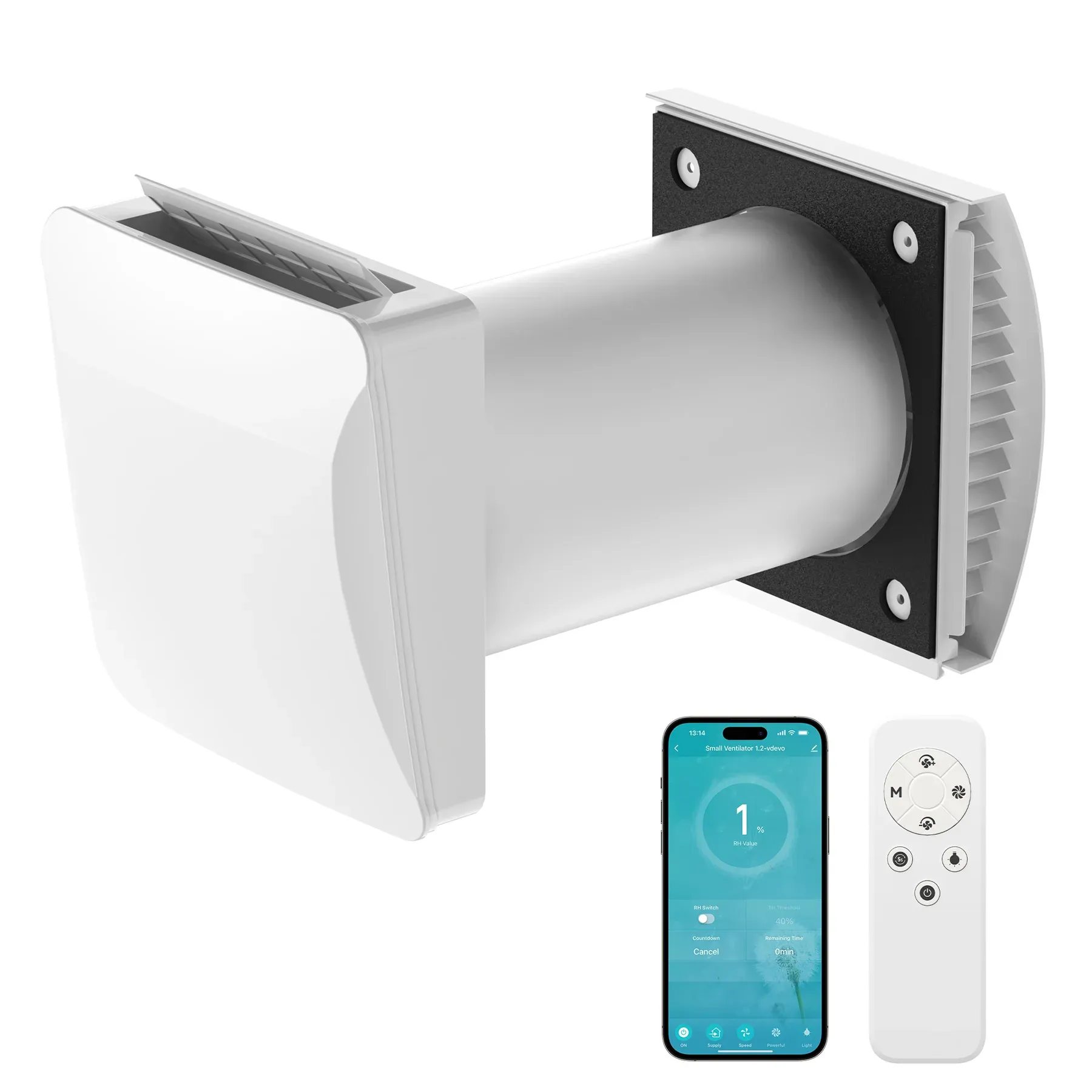
 Air Humidity Humidity-controlled single room heat recovery through one hole in the wall.
 Air Humidity WiFi Air Humidity with app control, schedules and group control from your phone.
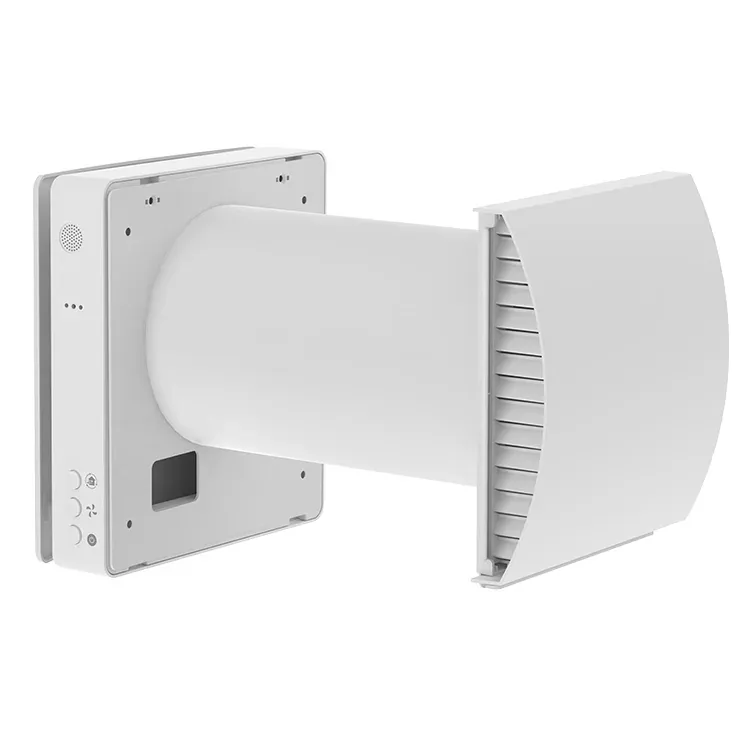 Air+ Humidity WiFi Humidity sensing, free cooling, IPX4 and a magnetic curved front.
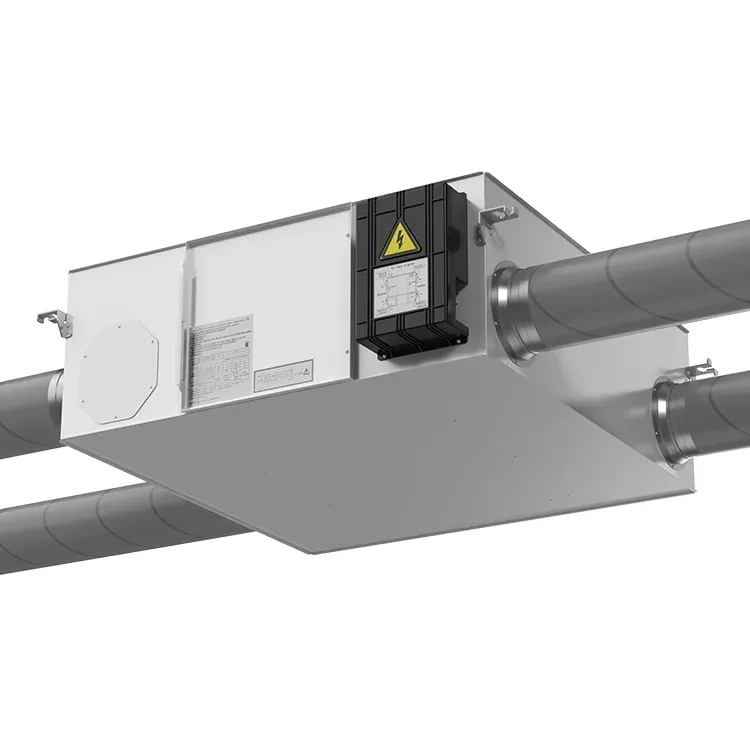 Breathe Ducted ceiling mounted heat recovery from 150 to 1,000 m³/h.