
How single room heat recovery works
At a glance
- Stale air warms a ceramic core on its way out.
- After 75 seconds the fan reverses and fresh air takes that heat back.
- Compatible wireless units pair so one supplies while the other extracts.
- Breathe supplies and extracts at the same time through ducts in a ceiling void.
The 75 second cycle
Drag the slider to stop the cycle at any second.
How one fan saves the heat
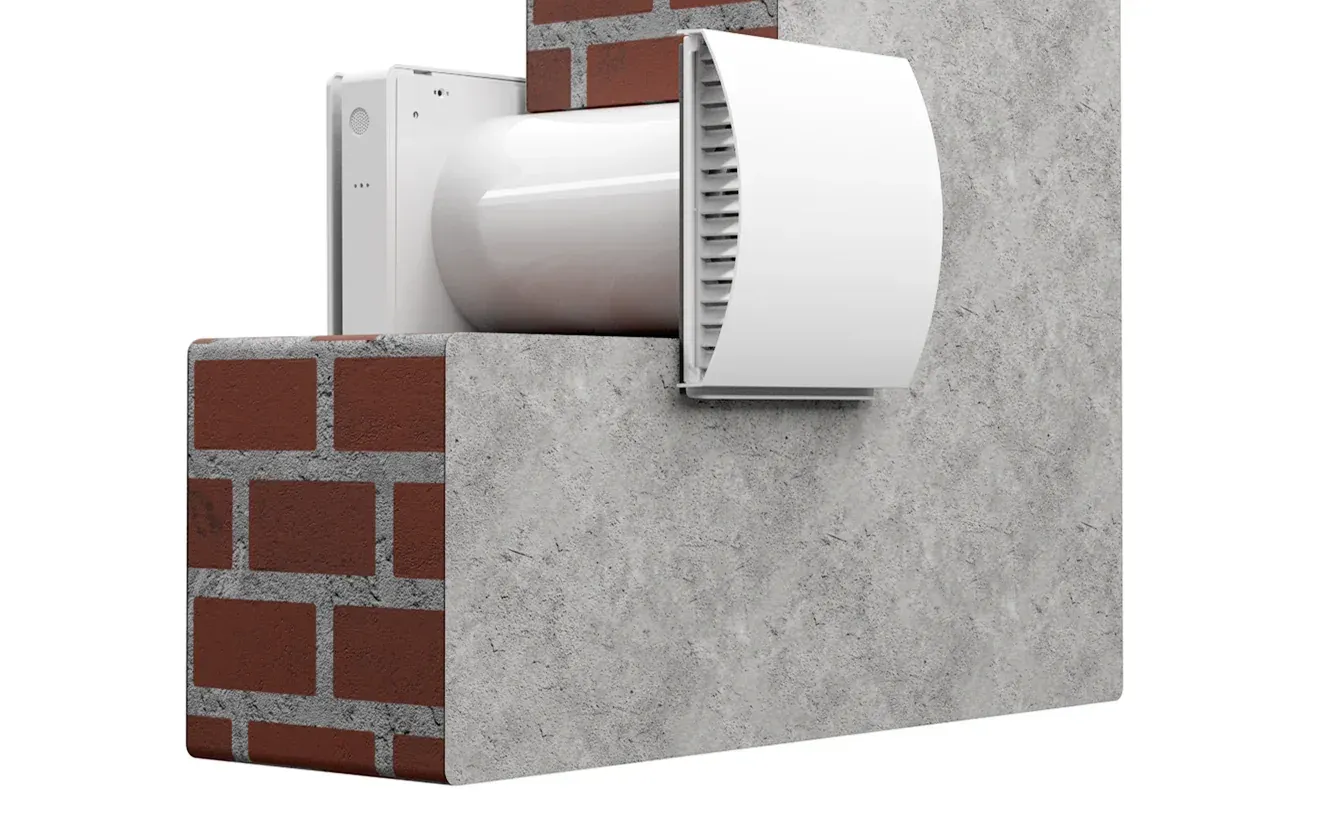
A single room unit such as Ventara Air Humidity has one reversible fan and a ceramic core. For 75 seconds it pushes stale room air out. The core soaks up its warmth. Then the fan reverses. Fresh outdoor air is pulled in through the warm core and reaches the room close to room temperature.
In summer the same reversing cycle can recover cooling. Cooler room air chills the core. Hot outdoor air gives up some of its heat on the way in.
Two units balance the airflow
Pair two units and they work as a team. One supplies while the other extracts. They swap every 75 seconds so the room stays balanced. The leader and follower link wirelessly with no cable between them.
Wireless pairing is on Air Humidity WiFi and both Air+ models. Install paired units within 8 to 15 m of each other. Keep them away from metal frames and aluminium ceilings.
Seven parts. One hole in the wall.
A simplified view of the main components from the Ventara catalogue. Match the numbers to the parts below.
- 1Front panelCurved and magnetic. An auto shutter behind it closes when the unit stops.
- 2Pre-filterTwo washable pre-filters as standard.
- 3F7 filterFitted as standard on Air+.
- 4Ceramic coreStores and returns heat. Maximum heat recovery efficiency of 97%.
- 5Reversible EC fanThree speeds. Reverses every 75 seconds in heat recovery mode.
- 6Wall sleeveThe 158 mm diameter duct through the outside wall.
- 7Outer hoodRainproof cover on the outside wall.
Air+ shown. The Air models have a square front panel and an optional F7 filter.Not to scale.
Heat recovery terms explained
What is a ceramic regenerator?
A ceramic regenerator is the heat store inside every Air and Air+ model. Its cellular ceramic structure gives a large contact surface. Outgoing room air warms it for 75 seconds. The fan then reverses and incoming fresh air takes that heat back. On Air+ the core is treated to prevent bacterial growth.
What is MVHR and how is an ERV different?
MVHR means mechanical ventilation with heat recovery. Fans bring fresh air in and take stale air out while heat passes from the outgoing air to the incoming air. Breathe is an energy recovery ventilator. Its total heat exchanger recovers moisture as well as heat. Its specifications list enthalpy efficiency next to temperature efficiency.
Ducted ventilation works differently
Ventara Breathe supplies and extracts at the same time through a total heat exchanger in the ceiling void. It suits a whole floor with room for ducts.